Area Information
2026/02/27
When establishing an office in Osaka City, it is essential to understand the features and transportation convenience of each area. From hubs with excellent wide-area access like Shin-Osaka and the Osaka Station area, to the prestigious business districts of Yodoyabashi and Nakanoshima, the commercial-residential mixed-use areas of Hommachi and Shinsaibashi, the southern gateways of Namba and Tennoji, and even Sakishima, which is gaining attention as a research and development hub—each location possesses distinct strengths.
This article explains the features and transportation convenience of Osaka's major areas, along with tips for selecting a location that aligns with your company's business needs. When evaluating business districts, consider factors beyond just rent comparisons—focus on perspectives that directly impact operational efficiency, corporate image, and recruitment capabilities.
Features of the Shin-Osaka Area
The Shin-Osaka area is a leading business hub in Osaka City's Yodogawa Ward, developed around a Shinkansen station that connects directly to the rest of Japan.
Shin-Osaka Station is the only terminal in Osaka Prefecture where the Tokaido and Sanyo Shinkansen bullet trains stop, serving as the gateway to Osaka. Located north of Umeda and adjacent to the city center across the Yodo River, it hosts not only Kansai-based companies but also numerous Osaka branches and sales offices of national corporations. In recent years, it has seen an influx of companies in the new energy and life sciences sectors, characterized by rising demand for office space.
The area around the station features numerous office buildings, business hotels, and chain restaurants, providing a well-established infrastructure for accommodating business travelers and visitors. Meanwhile, just a short distance from the station, residential neighborhoods and apartment complexes spread out, creating an environment where urban functions and residential functions coexist in close proximity.
Osaka City has designated the area around Shin-Osaka Station as the “Western Gateway,” advancing the development of exchange facilities and redevelopment projects. This area also serves as a nationally accessible business base for small and medium-sized enterprises, enabling them to operate with greater flexibility.
Transportation Convenience in the Shin-Osaka Area
The Shin-Osaka area is one of Kansai's major transportation hubs, where the Shinkansen, conventional rail lines, and subways converge.
Shin-Osaka Station is served by the Tokaido and Sanyo Shinkansen lines, providing direct access to Tokyo, Nagoya, Hiroshima, and Hakata. Trains also connect directly to the Kyushu Shinkansen, enabling travel to Kumamoto. JR conventional lines include the Kyoto Line, Kobe Line, Takarazuka Line, and Osaka-Higashi Line. Using the Limited Express service, you can reach Kyoto Station or Kobe Station in approximately 30 minutes.
Using the Osaka Metro Midosuji Line, you can reach Umeda Station in about 6 minutes, Yodoyabashi Station in about 9 minutes, Namba Station in about 15 minutes, and Tennoji Station in about 25 minutes. To Kansai International Airport, it takes about 50 minutes via the JR Limited Express Haruka. Airport buses operate to Itami Airport, ensuring excellent connections to air travel.
Access to the Shin-Midosuji Expressway and the Chugoku Expressway is also secured, making it an ideal location for companies with frequent business trips and wide-area sales operations.
Features of the Area Around Osaka Station
The area around Osaka Station is one of Kansai's leading business hubs, developed around one of western Japan's largest transportation terminals.
The area around Osaka Station and Osaka Umeda Station is located in Kita Ward, Osaka City, serving as a major transportation hub where JR, Hankyu Railway, Hanshin Electric Railway, and Osaka Metro converge. Over the years, it has developed as a central hub for shopping and leisure, with department stores and large commercial facilities clustering here. In recent years, redevelopment has progressed, particularly in the “Umeda” area, and the supply of large-scale office buildings continues. The area has established its status as a business hub, boasting one of the largest volumes of new office space supplied within Osaka Prefecture since 2012.
The entire district boasts strong brand recognition and is highly regarded for its advantages in attracting businesses and recruiting talent. With commercial, lodging, and dining functions concentrated in one area, it also contributes to improved visitor services and employee satisfaction. For small and medium-sized enterprises seeking a prominent base within Osaka City, this area presents a compelling option.
Transportation Convenience Around Osaka Station Area
The area around Osaka Station is a transportation hub offering extensive access covering the entire Kansai region. Centered around JR Osaka Station, multiple lines converge here, including Hankyu Osaka Umeda Station, Hanshin Osaka Umeda Station, and Osaka Metro Umeda Station. It is conveniently close to Shin-Osaka Station, just one stop away on the JR line (about 4 minutes), making it easy for business trips using the Shinkansen. It takes about 30 minutes by express bus to Osaka International Airport (Itami Airport), and Kansai International Airport is also accessible via the JR Haruka Limited Express and other services.
In March 2023, the underground platforms of JR Osaka Station opened in the Umeda area, with the Osaka-Higashi Line, the Haruka Limited Express, and the Kuroshio Limited Express now serving the station. A key advantage is the seamless underground connection between the seven major stations, enabling smooth travel even in rainy weather. In March 2023, the underground platforms of JR Osaka Station opened in the Umeda area, with the Osaka East Line, Limited Express Haruka, and Limited Express Kuroshio services now operating there. A key advantage is that the seven main stations are connected underground, enabling smooth travel even in rainy weather.
The area around Osaka Station offers excellent transportation access, supporting commuting and business activities throughout the entire Kansai region.
Features of the Yodoyabashi and Nakanoshima Area
The Yodoyabashi and Nakanoshima area is a business district with tradition and prestige that has long served as the economic heart of Osaka.
Yodoyabashi is located in the central section of Midosuji Avenue and has long been a hub for Osaka's financial, chemical, and pharmaceutical companies. It hosts the headquarters and major offices of companies such as Sumitomo Mitsui Banking Corporation, Osaka Gas, Sumitomo Chemical, and Shionogi & Co., with the Bank of Japan Osaka Branch and Osaka City Hall also nearby. It is highly regarded as a base for the financial, insurance, and information and communications sectors in Western Japan, which place a strong emphasis on corporate image, making it a prestigious location.
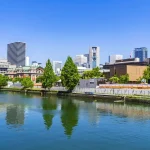
Nakanoshima is an area bordered by the Dojima River and the Tosabori River, featuring historic buildings such as the Osaka City Central Public Hall and the Osaka Prefectural Nakanoshima Library. In recent years, redevelopment has progressed with the opening of the Nakanoshima Museum of Art and the international future medical hub “Nakanoshima Qross.” A tranquil streetscape surrounded by water and greenery has been formed, offering an office environment that combines sophistication with innovation.
Transportation Convenience in the Yodoyabashi and Nakanoshima Area
The Yodoyabashi and Nakanoshima area offers excellent transportation convenience, providing direct access to central Osaka and the Kyoto area.
Yodoyabashi Station is served by the Osaka Metro Midosuji Line and the Keihan Main Line. Using the Midosuji Line, you can reach Umeda Station in about 3 minutes, Shin-Osaka Station in about 9 minutes, and Namba Station in about 6 minutes. Its location, allowing quick access to both Kita and Minami—Osaka's major transportation hubs—is a significant advantage for business activities and commuting.
The Keihan Main Line originates at Yodoyabashi Station, providing direct service to Gion-Shijo Station in Kyoto in approximately 47 minutes and to Demachiyanagi Station in about 53 minutes. It also features a key commuter route connecting Osaka and Kyoto. Within walking distance are Kitahama Station and Higobashi Station, offering access to the Sakaisuji Line and Yotsubashi Line.
The Yodoyabashi and Nakanoshima area, with its multiple rail lines, offers a transportation environment well-suited for wide-area business.
Features of the Hommachi and Shinsaibashi Area
The Hommachi and Shinsaibashi area is the core district of central Osaka, where traditional business functions blend with the vibrant energy of commerce.
Hommachi is located midway along Midosuji Avenue and has developed since ancient times as the center of the textile industry, known as “Semba.” Representative companies such as Itochu Corporation, Marubeni Corporation, and Toyobo Co., Ltd. originated in this area. Even today, textile-related companies and specialized trading firms cluster around the Senba Center Building, maintaining its character as a solid business district. Along Midosuji Avenue, mixed-use facilities like Hommachi Garden City are located, with orderly streetscapes and rows of ginkgo trees adding to its dignified atmosphere.
Meanwhile, the adjacent Shinsaibashi area to the south is a commercial hub centered around Daimaru Shinsaibashi and Shinsaibashi-suji Shopping Street, where fashion, beauty, and tourism-related businesses thrive. It also sees high demand for headquarters functions in retail and services, creative enterprises, and inbound tourism-related operations, making it a diverse area attracting a wide range of industries.
Transportation Convenience in the Hommachi and Shinsaibashi Area
The Hommachi and Shinsaibashi area offers excellent transportation convenience, with direct access to major terminals within Osaka City.
Hommachi Station is served by three lines: the Osaka Metro Midosuji Line, Yotsubashi Line, and Chuo Line. Using the Midosuji Line provides direct access to Shin-Osaka Station in about 11 minutes, Umeda Station in about 5 minutes, Namba Station in about 4 minutes, and Tennoji Station in about 11 minutes. The Yotsubashi Line runs directly to Nishi-Umeda and the Osaka Bay area, while the Chuo Line connects to the Osaka Port area via Tanimachi 4-chome Station and Morinomiya Station.
Shinsaibashi Station is served by the Midosuji Line and Nagahori Tsurumi-ryokuchi Line, enabling quick access to Namba Station and Hommachi Station. With its extensive coverage, it provides a transportation network that supports business activities and store operations in the city center.
Features of the Namba and Minatomachi Area
The Namba and Minatomachi area is the southern gateway to Osaka's Minami district, serving as its core where commerce, tourism, and culture converge.
Namba is located at the southern end of Midosuji Avenue and has developed into a major commercial district centered around Takashimaya Osaka and Ebisubashi Shopping Street. While home to facilities steeped in history and tradition like Dotonbori, Hozenji Yokocho, and the National Bunraku Theater, it also features mixed-use commercial complexes such as Namba Parks and Namba City, attracting numerous visitors from both Japan and abroad. Recent years have seen the addition of new lodging facilities and the reorganization of pedestrian spaces, further strengthening its role as a tourist hub.
The Minatomachi River Place complex is located in the Minatomachi area on the west side, housing live music venues, offices, and commercial facilities. The promenade along the Dotonbori River is lined with restaurants and eateries, making it a focal point for youth culture and information dissemination. The area offers an environment well-suited for consumer-facing businesses and tourism-related ventures.
Transportation Convenience in the Namba and Minatomachi Area
The Namba and Minatomachi area is a terminal hub with an extensive transportation network, including direct access to Kansai International Airport.
From Nankai Electric Railway's Namba Station, direct access to Kansai International Airport is available via the Rapid Express and other services. JR Namba Station, Kintetsu Osaka Namba Station, Hanshin Osaka Namba Station, and Osaka Metro's Midosuji, Yotsubashi, and Sennichimae Lines also connect here, providing excellent access to destinations both within and outside Osaka City. Direct service to Nara is available via the Kintetsu Line, and to Wakayama via the Nankai Line, covering the wider Kansai region.
The Minatomachi area is home to OCAT (Osaka City Air Terminal), serving as a hub for airport limousine buses and express buses. It functions as a transportation nexus integrating rail and bus services, offering a highly convenient location for companies engaged in tourism, inbound operations, and wide-area business activities.
Features of the Kyobashi and OBP Area
The Kyobashi and OBP area is a business hub that combines a lush green environment adjacent to Osaka Castle Park with advanced urban functionality.
Since its opening in 1986, OBP (Osaka Business Park) has been developed under the concept of a “business district within a park.” Alongside landmarks like Crystal Tower, TWIN21, and the Panasonic IMP Building, it hosts major corporate headquarters such as the Yomiuri TV Headquarters Building and KDDI Osaka Building No. 2. The area employs approximately 45,000 people and sees a peak daytime population of around 100,000 to 150,000, making it one of Kansai's leading business hubs.
Concert halls, hotels, and commercial facilities are also located here, developing as a mixed-use city where business, culture, and exchange converge. Osaka Prefecture and Osaka City have adopted a growth strategy for the “Higashi” area and are also focusing on supporting startups. This area is well-suited for companies that value a balance between urban functionality and natural surroundings.
Transportation Convenience in the Kyobashi and OBP Area
The Kyobashi and OBP area boasts high transportation connectivity, with multiple train lines intersecting.
JR Kyobashi Station is served by the Osaka Loop Line, JR Tozai Line, and Keihan Main Line, among others, and also connects to the Keihan Main Line and Osaka Metro Nagahori Tsurumi-ryokuchi Line. OBP Station (Osaka Metro Nagahori Tsurumi-ryokuchi Line Osaka Business Park Station), Osaka-jo Kitazume Station, and Osaka-jo Koen Station are also within walking distance, offering the convenience of access to six stations.
Osaka Station is approximately 10 minutes away via the JR Osaka Loop Line, and Shin-Osaka Station is accessible with just one transfer. Using the Keihan Main Line provides direct access to Kyoto, accommodating commutes across a wide area. Travel to Kansai International Airport is also possible via JR or the Keihan Line, offering a transportation network well-suited for business trips and accommodating visitors.
Features of the Abeno and Tennoji Area
The Abeno and Tennoji area is a hub that combines a history of development as the gateway to southern Osaka with growth potential driven by redevelopment.
Tennoji has long served as a key transportation hub connecting southern Osaka, Nara, and Wakayama with central Osaka. In 2014, the Abeno Harukas skyscraper opened at approximately 300 meters above ground. This landmark complex, featuring a department store, hotel, offices, an art museum, and an observation deck, has generated new vitality. Surrounding the area, large commercial facilities like Abeno Q's Mall and Abeno Lucis have clustered, enhancing the district's commercial functions.
On the other hand, the area is also characterized by its proximity to historical, cultural, and natural attractions such as Shitennoji Temple, Tennoji Park, Tennoji Zoo, and the Osaka City Museum of Fine Arts. The Abeno and Tennoji area is a place where it's easy to balance a good working environment with convenient living.
Transportation Convenience in the Abeno and Tennoji Area
The Abeno and Tennoji area is Osaka's third-largest transportation hub, where multiple rail lines converge.
JR Tennoji Station is served by the Osaka Loop Line, Yamatoji Line, and Hanwa Line, and also provides access to the Osaka Metro Midosuji Line and Tanimachi Line. Kintetsu Minami-Osaka Line's Osaka Abenobashi Station and Hankai Tramway Kamimachi Line's Tennoji Ekimae Station are also within walking distance, bringing the total number of converging lines to five or more. Using the Midosuji Line allows direct access to Hommachi Station and Yodoyabashi Station without transfers.
Direct trains also run to Nara and Wakayama areas, and Kansai International Airport is accessible via the Haruka Limited Express or Kansai Airport Rapid Service. The Abeno entrance to the Hanshin Expressway Matsubara Line is nearby, facilitating car travel. This area boasts excellent transportation convenience centered around its rail network.
Features of the Sakishima Cosmo Square Area
Sakishima Cosmo Square Area is an international hub for business and research and development located on the Osaka Bay waterfront.
Sakishima is an artificial island spanning approximately 1,000 hectares, with the Cosmo Square district covering about 154 hectares in its northern part. Development accelerated in earnest after the 1970s, with facilities such as the Asia Pacific Trade Center (ATC), the Osaka Prefectural Sakishima Government Building (Sakishima Cosmo Tower), and INTEX Osaka located there. The National Institute of Technology and Evaluation (NITE)'s large-scale battery system testing and evaluation facility, “NLAB,” is also situated here, promoting the clustering of new energy and life science industries.
The area is undergoing revitalization as a mixed-use city where data centers, research facilities, universities, hotels, and residences coexist, with large-scale public-private partnerships continuing. Its environment, blessed with waterfront views and green spaces, offers an openness distinct from the city center, making it an ideal area for research and development companies and internationally oriented businesses.
Transportation Convenience in the Sakishima Cosmo Square Area
Sakishima Cosmo Square Area is a waterfront terminal offering convenient access to both the city center and the airport.
Cosmo Square Station on the Osaka Metro Chuo Line is the main station, offering direct access toward Hommachi Station. It takes approximately 20 minutes by train or car to reach central Osaka, making it suitable for business commutes. Kansai International Airport is about a 40-minute drive away, providing convenience for companies engaged in international logistics and overseas transactions.
The surrounding area features a concentration of facilities including the Hanshin Expressway Wangan Line entrance/exit, Osaka Port's container terminal, and ferry terminal, providing robust logistics capabilities. Access to INTEX Osaka, where exhibitions and international conferences are held, is also excellent, creating a transportation environment that supports wide-area business and international exchange.
Summary
Within Osaka City, diverse options exist: Shin-Osaka, suitable for nationwide hubs; the Osaka Station area, boasting the strongest brand presence in Western Japan; Yodoyabashi and Nakanoshima, rich in tradition and prestige; Hommachi and Shinsaibashi, where commerce and business converge; Namba, strong as a tourism and consumption hub; Tennoji, undergoing redevelopment; and Sakishima, a research and development base.
The Yodoyabashi and Higobashi area stands out as a prime location, offering both excellent transportation access via the Midosuji Line and Keihan Main Line, and a calm business environment. The “Tensho Office Higobashi,” scheduled to open in early April 2026, and the “Tensho Office Yodoyabashi,” scheduled to open in early May 2026, offer attractive cost benefits such as two hours of free meeting room use daily and the ability to register a corporation. Companies seeking a base that balances convenience and cost-effectiveness are encouraged to consider these options.
Tensho Office Higobashi
Tensho Office Yodoyabashi
See more